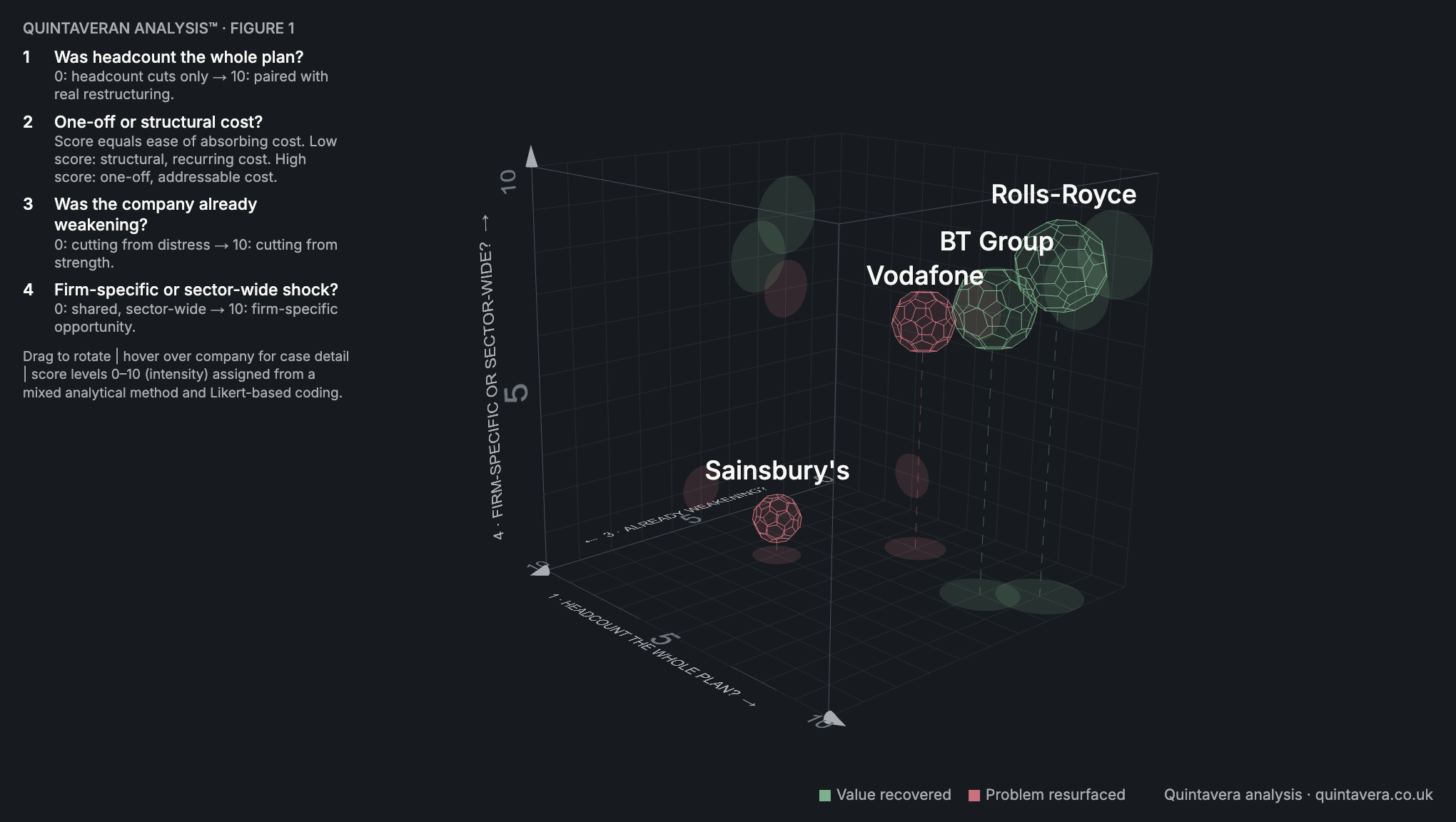

This article is the first of a series of inquiries using Quintaveran analysis™ that unearth interesting perspectives to inform executive decision-making.
With 2026 shaping up to be another record year for UK workforce redundancies*, Office for National Statistics (ONS) data were used to consider whether firms that cut staff and firms that didn’t were ultimately on the same trajectory anyway, once the shock that caused both the redundancies and the productivity change was controlled for.
Did redundancies drive enterprise recovery, or simply coincide with it?
Whilst it would be easy to conclude that dramatically reducing a workforce would have an immediate hit on profitability and near-term competitiveness, the opposite is true in many cases. After all, redundancies spike in recessions, and recessions are mechanically followed by above-trend recoveries in both productivity and profitability. That’s until you look a bit deeper.
The headline numbers don’t tell the whole story.
Pre-trend and falsification checks and industry-sector realities are also important considerations, so we layered in a narrative-informed interaction test and qualitative comparative analysis (QCA), taking a deliberately small number of well-documented cases, scoring each on a fixed set of conditions derived from theory, and then considering which combination of conditions travels with a good outcome versus a bad one. Note that analyses of this kind often over-index on the 2024–2026 UK retail and telecoms cost-driven wave (BRC, Sainsbury’s, Vodafone, BT) as a test case when, in reality, it is too young to answer the question.
The analysis shows the reality is very different.
Redundancies themselves rarely move enterprise value. It’s what the company does alongside them that does, and the result takes about two years to show up either way.